AMRs
AMRs (autonomous mobile robots) enable flexible and autonomous material transport in warehouses, production facilities, and distribution centers. Unlike fixed transport systems, these mobile robots navigate independently and adapt to changing environments without requiring predefined routes. At AGVR, AMRs are implemented as part of complete intralogistics solutions that improve internal material flow while increasing efficiency and maintaining safe operations.
Discover whether AMRs are the right fit for your logistics operation
Including projects involving small vehicles
24/7 customer service
Custom AGV solutions
What Are AMRs?
AMRs are intelligent transport vehicles that move materials autonomously throughout a facility. Unlike traditional AGVs, AMRs determine their own routes using sensors, mapping technology, and intelligent software instead of relying on fixed guidance such as magnetic tape or reflectors. This allows AMRs to determine the most efficient route while safely avoiding obstacles and adapting to changes in their surroundings. Compared to conventional transport systems, autonomous mobile robots offer greater flexibility because routes can be modified through software rather than physical infrastructure. This makes them suitable for environments where production layouts or logistics processes change over time.
Tractor AGVs
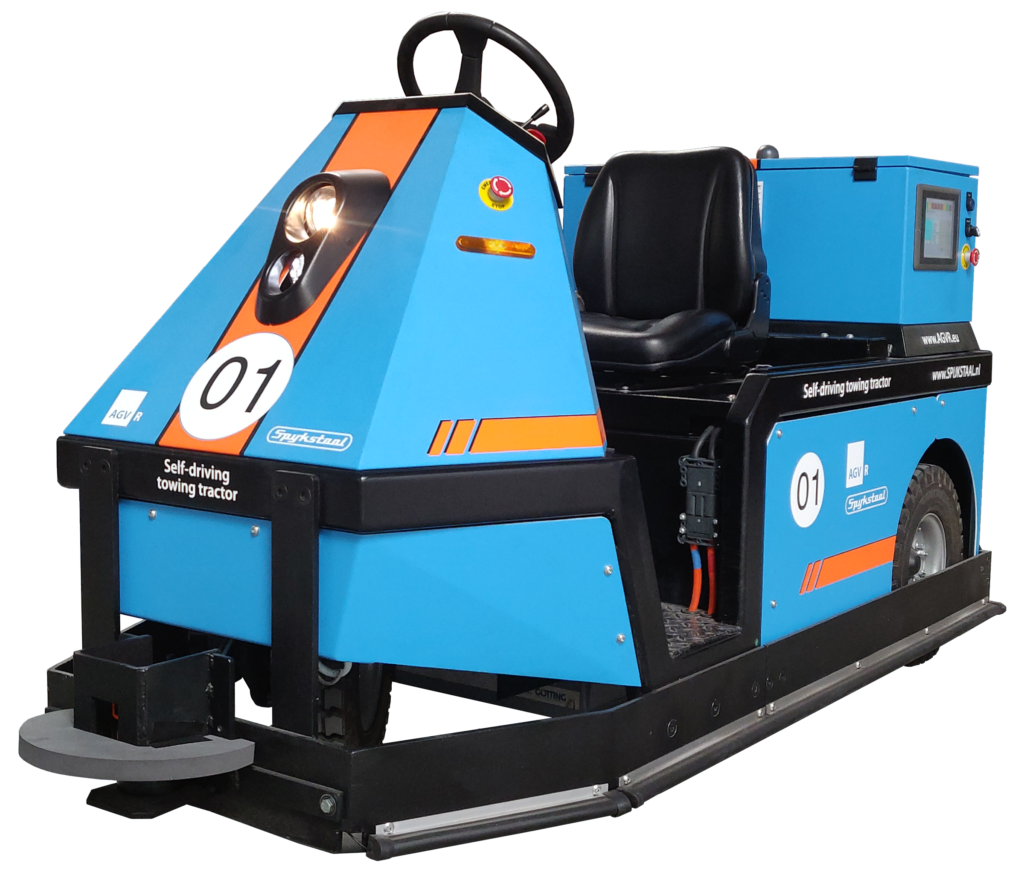
Tugger Tricycle
- Towing force: up to 10 tons
- Hybrid operation: automatic and manual
- Use: indoors and OUTDOORS

Tugger Four-Wheeler
- Towing force: up to 60 tons
- Hybrid operation: automatic and manual
- Use: indoors and OUTDOORS
Common Applications
AMRs are used in a wide range of intralogistics applications where flexible material transport is essential. Common applications include pallet transport, line supply, warehouse replenishment, buffer transport, and moving goods between production cells or storage locations. Because AMRs can easily adapt to changing workflows and facility layouts, they are suitable for industries such as manufacturing, warehousing, and distribution.
How Do Autonomous Mobile Robots Work?
AMRs continuously scan their environment using technologies such as LiDAR, safety scanners, cameras, and onboard navigation software. They create a digital map of the facility and calculate the most efficient route to their destination while responding to real-time conditions. If a route becomes blocked, AMRs automatically calculate an alternative path to avoid congestion and maintain uninterrupted material flow. Because AMRs make routing decisions independently, they can safely operate alongside employees, forklifts, and other automated vehicles. Fleet management software coordinates multiple AMRs, helping to optimize transport flows and prevent unnecessary waiting times or congestion.
Platform AGVs

Crawl-under
- Maximum loading weight: 1000 kilograms
- Height minimum: 0.3 meters
- Lift stroke 0.1 meters
- Use: indoors

Conveyor
- Type of conveyor: chain, roller, or belt conveyor
- Maximum loading weight: 2500 kilograms
- Loader: side or front loader
- Use: indoors and outdoors
Why Choose AMRs?
Organizations increasingly implement autonomous mobile robots because they combine autonomous navigation with operational flexibility. As logistics requirements change, AMRs can easily be expanded or reconfigured without extensive modifications to the facility.
Key advantages include:
- flexible routing without fixed infrastructure;
- safe navigation in dynamic environments;
- scalable automation as operations grow;
- reliable transport of materials between locations;
- better utilization of available warehouse and production space.
These characteristics make AMRs suitable for organizations looking to automate internal transport while maintaining flexibility for future developments.
AMRs Within an Integrated Intralogistics Solution
Implementing AMRs involves more than introducing autonomous vehicles. A successful solution also considers transport processes, system integration, traffic management, and future scalability. As a specialist in AGVs and AMR solutions, we can integrate autonomous mobile robots with warehouse management systems (WMS), manufacturing execution systems (MES), ERP software, and other automation platforms to support coordinated material handling across the entire facility. Every implementation is based on the operational requirements of the environment, ensuring that the AMR solution aligns with existing workflows while remaining adaptable as logistics processes evolve.
Clamp AGVs

Round loads
- Type of clamp: reel clamp (single or double)
- Maximum loading weight: up to 6 tons
- Lift height: up to 8 meters

Square loads
- Type of clamp: plate clamp
- Maximum loading weight: up to 1000 kilograms
- Lift height: up to 8 meters
Explore the Possibilities for Your Facility
A well-designed AMR solution creates a flexible foundation for efficient internal transport and long-term operational development. Whether you are exploring automation for a specific transport process or looking to optimize your complete intralogistics operation, the right approach starts with understanding your logistics requirements. Request a quote or call us at +31 6 53 15 35 94 to discuss your application.
NETHERLANDS
+31 (629) 355852
Ebweg 14, 2991 LT Barendrecht
9:00 – 17:00 (Mon – Fri)
Secretary@agvr.eu
Sales
Wim Luijendijk
+31 (653) 153594
Wim.luijendijk@agvr.eu
 GERMANY
+31 (629) 355852
Ebweg 14, 2991 LT Barendrecht
9:00 – 17:00 (Mon – Fri)
Secretary@agvr.eu